By: Sara Fitzgerald, Summer 2025 Intern
For millions of high school athletes across the United States, sports are more than just games; they are a way of life. Nearly eight million students in the US participate in high school athletics each year, mostly driven by the dream of advancing to the next level. This dream drives them to train harder, compete longer and push their limits.
However, the reality to advance to the next level is humbling. According to the NCAA, only about 530,000 high school athletes advance to collegiate competition, a small percentage ranging from roughly 3% to 14%, depending on the sport. Additional opportunities exist through the National Association of Intercollegiate Athletics (NAIA), which supports around 83,000 student-athletes at 237 schools. Even when combining NCAA, NAIA, and NJCAA (junior college) programs, fewer than 1% of high school athletes continue their athletic careers after graduation.
These statistics highlight a tough reality. For many athletes, high school is their final stop in competitive sports. For seniors, this moment is a defining crossroads filled with opportunity, uncertainty and emotion. Do they continue playing or is this the final chapter? Whether chasing scholarships, feeling burnt out, or shifting focus toward academics and future careers, this decision profoundly impacts identity, purpose, and the path ahead.
“My high school experience influenced my college decision because I had so much fun competing with my friends and teammates and growing relationships that last forever while playing the sport I love,” said Jackson Saroney, a Jamesville DeWitt High School (Section III) graduate and Penn State golf commit.
Saroney was the 2025 NYSPHSAA Boys Golf State Champion this past spring and set a tournament record for 10-under.
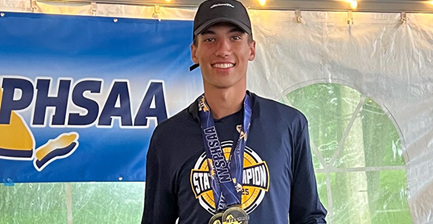
Jackson Saroney poses after earning the NYSPHSAA Boys Golf Championship Title
“I’ve always been super competitive in every sport I’ve played growing up, but I grew to love golf—especially competitive golf—once I started playing tournaments. I knew I wanted to keep going in college and continue playing for as long as possible,” said Saroney. “Penn State felt like the perfect fit the moment I stepped on campus. Having golf courses and practice areas on campus was huge because I wanted to practice as much as possible. Coach Leon and Coach Ziccardi are great mentors, and I really feel like I can grow as a player under their leadership.”
Athletic scholarships often play a big role. The NCAA awards over $3.6 billion annually in scholarships to Division I and II athletes while NAIA programs offer additional financial aid. For many, college sports are not only about competition but also a way to help fund their education. A demand for an athlete often results in a greater financial package and thus is a win-win for athlete, coach and the athletic program.
“What led to my commitment to Georgetown was the coaching staff,” said Tatum Cramer, a Guilderland High School graduate (Section 2) and Georgetown University track commit. “From my very first phone call with the jumps coach, we clicked instantly. During my visit, they told me they recruited me not just for my marks, but because they saw me handle a tough day with composure. That showed me how much they care about growing athletes as people. At Guilderland High School, I learned that being a good teammate is just as important as winning. The coaches and community prepared me well for the demands of college athletics.”
Tatum was a multi-NYSPHSAA State Champion in jump events in outdoor track and named Times Union Athlete of the Year this past spring setting records in the long jump and triple jump.
Tatum Cramer heads to Georgetown after a decorated high school career in Track & Field.
Beyond scholarships, many athletes continue simply because they love their sport. The routines of practice, competition, and team friendships have shaped their identities, and walking away would feel like losing a part of themselves. College teams provide instant friendships, mentorship, and support. For many freshmen, this community eases the transition to college life and becomes a critical part of their experience.
“I’ve never thought about quitting,” said Scott Lynch, a Mechanicville High School graduate (Section 2) and Siena University baseball commit. “Baseball is what I love and my parents love watching me compete. I want to give them that for as long as I can. What motivated me to keep playing baseball was a dream I’ve had since I was a little kid—to make it to the next level. Choosing Siena was easy. The moment I visited, it felt like home and I connected immediately with Coach Jurczynski and the rest of the coaching staff. I’m excited to make an impact on and off the field.”
Even though Lynch was a Section II soccer All-Star, he is heading to Siena on a baseball scholarship. A Section II baseball All-Star as well, he broke the school’s hits record this past spring was one of the top infielders in the section.
Scott Lynch used his multi-sport high school career to earn a Baseball scholarship at the Division I level.
On the contrary, many athletes view college as a launchpad for larger ambitions and don’t see athletics fitting into the picture. For these individuals, personal development of their career beyond college takes priority ahead of continuing an athletic career.
“I loved my experience in high school playing lacrosse and soccer for four years but it was time to hang them up as they say and focus on academics and a career,” said Andrew Altieri, a Guilderland High School (Section 2) graduate and incoming freshman at University of Rhode Island this fall. “I even enjoyed the recruiting process for lacrosse for like a year talking to coaches and visiting campuses but felt my choice for college should be dictated by what I wanted to do as a career and ultimately focus all my work on my major when I got there.”
Altieri, who opted not to continue to play and rather focus on studying kinesiology at URI, was a Section 2 lacrosse All-Star tallying one of the top win rates among faceoff players this past spring including 52-for-78 wins in two games the final week of the season.
After the college recruitment process, Andrew Altieri looks forward to the college experience not as a student-athlete.
For many high school athletes, graduation marks the end of their competitive sports journey, a decision that is often thoughtful and valid. Coach Tyler Prendergast, head track & field coach at Mechanicville High School, helped shed some light on the common reasons athletes decide not to continue.
“There are many factors that can lead to the end for athletes,” said Prendergast. “Years of intense training can create burnout and both physical and mental exhaustion. Also, injury concerns, academy and career goals, and other priorities put athletic careers on the backburner.”
Coach Prendergast points out a common mindset among his athletes and many others as well.
“I think a lot of students start off really thinking it’s Division I or bust. A lot of athletes think going anything less than Division I is a little bit of a failure, while Division II and Division III have some really good competition. Some have Division I caliber skills but choose Division III for various reasons. And some genuinely just wanted something to do in high school and never even considered playing in college.”
Ending a sports career can be an emotional challenge, especially for those who deeply identify as athletes. Without daily practices, games, and team connections, many feel a void or confusion about their social role once their athletic career ends. This transition sometimes leads to loneliness, lack of motivation, or depression, often called “post-sport depression.” Strong support from family, friends, coaches, and counselors can make a crucial difference.
“I definitely feel like there’s something missing now that sports are done for me,” said Altieri. “I’m counting on club and intramural opportunities at college to help fill that void for me but know that I’ll have more time on my hands to study and enjoy college overall.”
Like many coaches, Prendergast tries to entice former high school athletes to get involved in other ways to give back to the sport and help young athletes.
“I try to explain to them that if they think they have more to give or still want to be involved in the sport, maybe they’d be interested in coaching,” said Prendergast. “The phrase ‘those who can’t play, coach’ isn’t about ability—it’s about people who still have something to give to the sport in a different way.”
This phase also offers an opportunity for reinvention. Many former athletes channel their drive and discipline into student organizations, leadership roles, academics, or new careers.
“I also try to help students find other outlets like going to a smaller school to keep developing their skills or improving grades to transfer later. The key is realizing the path isn’t over—it just might change shape,” said Prendergast.
The end of high school sports isn’t just a season’s close; it’s the start of a new journey. Whether athletes choose to continue competing at the college level or move on, this transition marks a pivotal moment in life. It’s a chance to reflect on the lessons learned, friendships, and discipline sports provided, and to face the future with confidence. The skills learned on the field, court, or track don’t end—they evolve, guiding athletes wherever life leads next.