By: Dylan Shields, Fall '25 Intern
When the final whistle blows and athletes are celebrating hard fought victories, the spotlight usually falls on the players or coaches. But behind every successful team and every healthy athlete stands someone rarely seen, the athletic trainer.
They are working before the stadium lights turn on, before the fans arrive, and long after the teams have left the field or court. They’re wrapping, rehabbing, and preparing for their athletes.
Athletic trainers are highly trained medical professionals with expertise and dedication in ensuring that student-athletes can perform safely and confidently. They are the backbone behind every high school sports program, but their critical role doesn’t always get the recognition it deserves. In the world of high school sports, athletic trainers are often the unsung heroes.
Many people assume athletic trainers are there to just wrap ankles or hand out ice packs. But their responsibilities go far beyond that. Athletic trainers are nationally certified healthcare professionals trained in injury assessment, emergency care, rehabilitation, and mental wellness.
To become a certified athletic trainer, you must complete a master’s degree from an accredited athletic training education program and pass a comprehensive certification exam through the Board of Certification (BOC). To become eligible for the exam, it requires graduation from a CAATE-accredited program (Commission on Accreditation of Athletic Training Education).
Once certified, athletic trainers must complete ongoing education and work in collaboration with a physician under their state’s practice laws.
But certification is only part of the job. On a daily basis, they juggle a wide range of tasks. They go from evaluating injuries to figuring out the perfect rehab program. Prepare athletes before games and help them with recovery afterwards. They deal with paperwork and sign off on documentation. They’re often at school in the morning and stay well into the evening, while working weekends too.
Athletic trainers are more than helpful; they’re essential, qualified, and certified to care for athletes on and off the field. The New York State Public High School Athletic Association (NYSPHSAA) requires a trainer to be at every state championship contest.
Rick Knizek, the head athletic trainer at Shenendehowa High School since 1999 and member of the NYSPHSAA Safety Committee, knows this firsthand. In addition to his high school work, he serves as a medical provider for the U.S. Olympic and Paralympic Committee, working with elite athletes in sports like bobsled and skeleton.
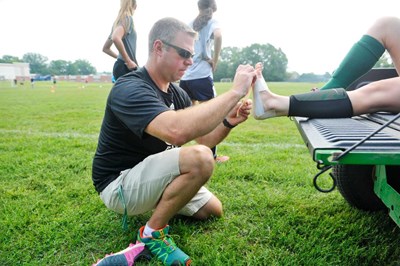
Rick Knizek, head athletic trainer at Shenendehowa tapes a fall athlete at the school. (Photo courtesy of Paul Buckowski/Times Union)
“I was a high school athlete myself. As a soccer player, I got injured while playing,” Knizek said. “I always wanted to pursue something that combined medicine and athletics, and I ended up majoring in athletic training in college.”
Now, he helps athletes with recovery every day, physically and emotionally.
“Motivating injured athletes can be very challenging,” he explains. “I try to use their own motivation for playing the sport to help them focus on recovery. A successful rehab can result in a stronger body and even better performance than before the injury.”
When a player does go down, all eyes are on the field or court. But the first person to act isn’t always the coach or a teammate. It’s the athletic trainer, and in those moments, they are first responders that must act quickly and confidently.
“Being the first person to respond to an injury requires patience, poise and the ability to make quick decisions,” Knizek says. “I need to determine the nature and severity of an injury as quickly as possible, while making sure the athlete’s safety is always the top priority.”
There’s added pressure in those moments too.
“Depending on the sport, there may be several thousand people watching every move I make,” he adds. “It’s imperative to display professionalism and competence in those moments.”
But once the crowd leaves and the game ends, the athletic trainer’s job isn’t done. Whether it’s helping athletes with treatment, filing reports, or evaluating injuries, they’re often the last ones out of the building. Rachael Shatney, the athletic trainer at Guilderland High School in Section 2, reflects on this reality.
“I don’t have a typical day,” she says. “The fall is the longest in regards to hours. I get to work around 11 a.m. and leave between 8:00 and 9:00 p.m., and I work almost every Saturday. I usually work all the fall holidays as well but its important I’m there for the school, athletes and coaches.”
In addition to those long hours, she often stops at the middle school in the morning before arriving at the high school to treat injured modified athletes. Shatney occasionally works Sundays during postseason play as well.
“I’ve been doing this for 22 years and I have mostly loved it, but I have some love-hate relationships with my job,” she adds. “I have great relationships with my athletes, they trust me. I also bring humor and light sarcasm to every situation, which helps tremendously when someone is hurting.”
Athletic trainers also play a crucial role in building relationships with athletes. They become someone who athletes talk to, trust, and rely on throughout the roller coaster ride of sports.
Sarah Domin, a senior at West Genesee High School in Section III who plays tennis and ice hockey, says her athletic trainer helps create a welcoming environment for all athletes.
“I don’t often go to my athletic trainer, but I know I can, and they are always very welcoming, validating, and helpful,” Domin said. “When you go to their office, there are plenty of individual routines, and they ask how your day was when you come in. My athletic trainer even hosts yoga for our hockey team, which helps so much as a goalie and prevents injuries.”
Former Carmel High School (Section I) athlete, Andrew Fiore, who now plays football at SUNY Cortland, also knows how important athletic trainers can be during a difficult recovery.
“My sophomore year of college was the first time an athletic trainer really helped me through an injury. I tore my ACL and meniscus during practice that year,” Fiore recalls. “My athletic trainer Molly Potvin was a huge help in my recovery. She helped me regain strength before surgery and handled the scheduling, which took off a huge amount of stress. She pushed me to keep going when I thought I couldn’t anymore.”
Athletic trainers do far more for athletes than the public eye can see. They build bonds with athletes and help them through both physical and mental hurdles. That level of trust can often be what keeps athletes going.
Shatney takes that responsibility very seriously, especially when it comes to mental health. She recalls an early internship where a crew athlete she worked closely with died by suicide after being sidelined by injury.
“It forever changed how I dealt with any athlete that was taken out of their sport for any length of time or permanently,” she says. “I always make sure that coaches and teammates are including injured athletes. I suggest they become managers, or help coach, or just come to my training room every day for check-ins.”
She also communicates with guidance counselors and coaches and watches closely for signs of mental or emotional distress. “It’s a real problem that we all need to be very aware of and we need to be there for any way we can help,” said Shatney.
Despite all their training, knowledge, and dedication, athletic trainers don’t always get the recognition they deserve.
“If I didn't have an athletic trainer, I would be screwed,” Fiore says bluntly. “I’ve had many injuries since playing college football, and they've always helped me get back on the field. The amount of knowledge they have is amazing. I would miss them pushing me and my teammates to keep working even when it gets hard.”
While some schools do, of course, show great appreciation for their trainers with team gear and validation. Others still overlook the contributions they bring to their school’s sports teams.
At West Genesee, Domin says trainers are appreciated. “At my school, they get team t-shirts and other accessories, they are well-supported,” she says. “But just knowing there’s someone there for you gives peace of mind. They’re super helpful, and someone always needs one.”
The reality is, without an athletic trainer on the sidelines, many teams wouldn’t be able to practice or compete safely. NYSPHSAA and many other organizations also appreciate the contributions and commitment of trainers to their events or they wouldn’t be able to host successful events.
In the world of high school sports, athletic trainers are essential. They are the unsung heroes behind the scenes, helping athletes play at their highest level. It’s time they received the recognition they’ve long deserved.